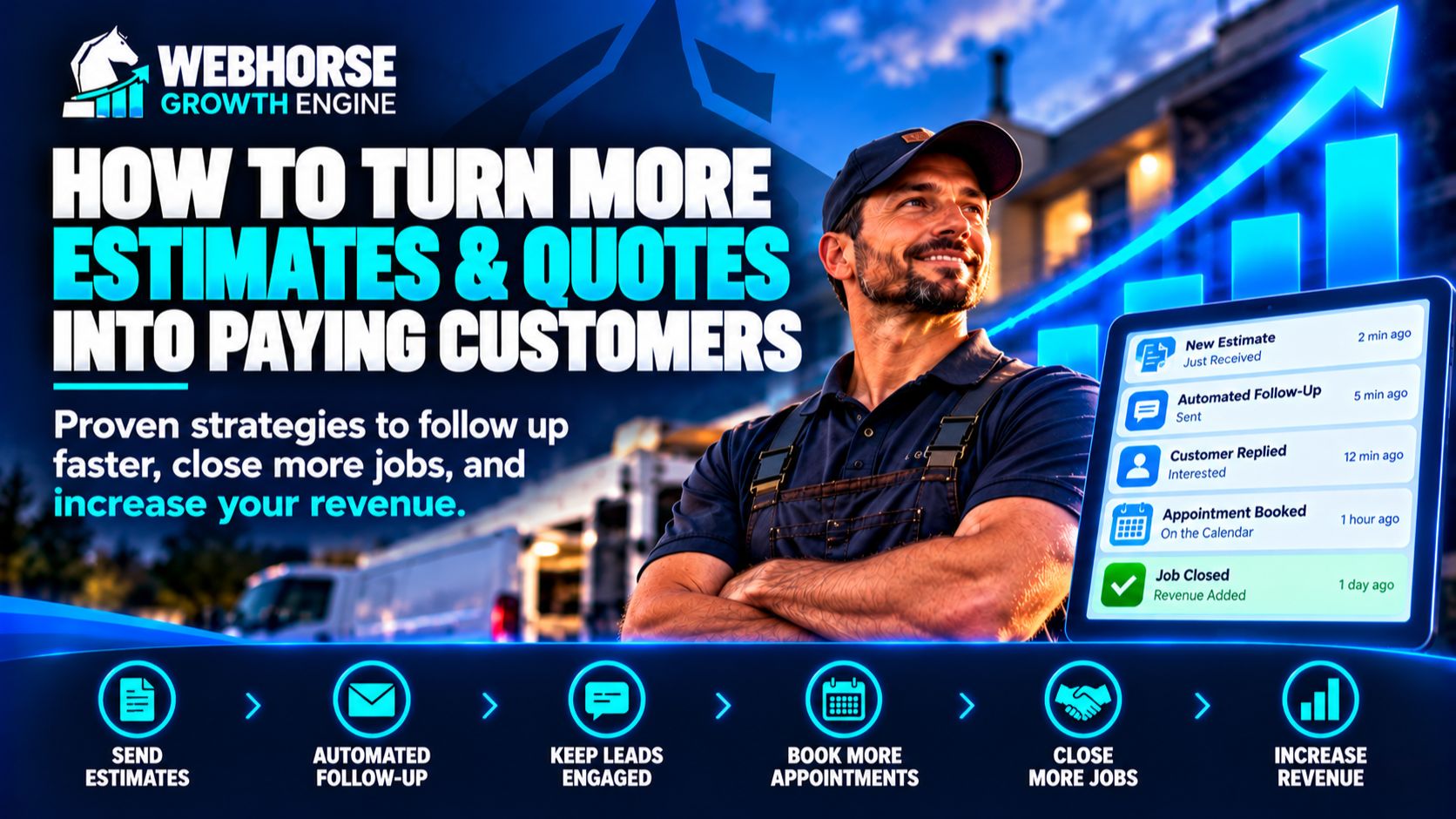
Your business is generating leads, scheduling appointments, and sending estimates. But how many of those opportunities actually become paying customers? Discover how a better estimate follow-up process could help you close more jobs without spending more on advertising.
Imagine this scenario.
A homeowner contacts your company about replacing their roof.
Your team responds quickly, schedules an appointment, visits the property, evaluates the project, and prepares a detailed $12,000 estimate.
The customer seems interested.
They ask a few questions, thank you for your time, and say they need to think about it.
You send the estimate.
And then?
Nothing.
A week goes by. Then two weeks.
Nobody follows up.
Eventually, the customer hires another contractor.
Sound familiar?
For many small businesses, the problem isn’t generating enough leads or even getting appointments scheduled.
It’s what happens after an estimate is delivered.
Every estimate represents an opportunity. But an opportunity doesn’t become revenue until the customer makes a decision and the business wins the work.
And while not every estimate will turn into a sale, having a consistent process for following up can help your business compete for more of the opportunities it’s already generating.
Let’s explore how to build that process, what to say to potential customers, how often to follow up, and how to make the entire system easier to manage.
Why Sending an Estimate Isn’t the Same as Closing a Sale
Many business owners spend considerable time thinking about how to generate more leads.
They invest in Google Ads, SEO, Facebook advertising, and professional websites to attract potential customers.
Then their employees spend time answering questions, scheduling appointments, and preparing estimates.
But here’s where an important disconnect can happen.
Once the estimate is delivered, the opportunity is treated as though the work is finished.
The customer has the price.
Now it’s up to them to decide.
Unfortunately, that approach overlooks an important part of the customer buying process.
Customers often have questions or concerns they haven’t fully expressed.
They may be comparing several companies.
They might need to discuss the purchase with a spouse or business partner.
They may not understand why one estimate costs more than another.
Or they might simply need more time to make a decision.
These are all normal situations, especially for higher-value purchases.
The challenge is that without a follow-up process, your team may never know what’s preventing the customer from moving forward.
Good estimate follow-up isn’t about pressuring customers. It’s about helping them make an informed decision while making sure your business doesn’t forget about them.
What Is an Estimate Close Rate?
Your estimate close rate measures the percentage of estimates that turn into approved jobs or sales.
It’s one of the most useful metrics for businesses that sell through quotes, proposals, inspections, or consultations.
The calculation is straightforward:
Estimate Close Rate = (Estimates Won ÷ Estimates Issued) × 100
Let’s say your company sends 40 estimates.
Of those, 10 become approved jobs.
Your estimate close rate is:
10 ÷ 40 × 100 = 25%
That means one out of every four estimates resulted in a sale.
But is 25% good?
It depends.
A contractor providing small repair estimates may have a very different close rate than a company selling $30,000 remodeling projects.
A customer who calls requesting immediate service has different buying intentions than someone gathering early pricing information.
The best starting point is to understand your own close rate and evaluate how it changes over time.
Make sure you use consistent definitions and allow sufficient time for estimates to reach a decision. For longer sales cycles, compare estimates issued during the same period rather than mixing old and new opportunities.
How Much Revenue Could Better Estimate Follow-Up Generate?
Let’s look at a hypothetical service business.
The company sends 40 estimates every month.
Each estimate averages $4,000.
Its current estimate close rate is 25%.
Here’s what that means:
| Metric | Current Performance |
|---|---|
| Estimates sent | 40 |
| Average estimate value | $4,000 |
| Estimate close rate | 25% |
| Jobs won | 10 |
| Gross revenue from won estimates | $40,000 |
Now imagine the company improves its sales process.
Estimates are clearer.
Employees follow up consistently.
Customers receive timely answers to their questions.
And the company improves its close rate from 25% to 30%.
| Metric | Improved Performance |
|---|---|
| Estimates sent | 40 |
| Average estimate value | $4,000 |
| Estimate close rate | 30% |
| Jobs won | 12 |
| Gross revenue from won estimates | $48,000 |
That’s an additional $8,000 in monthly gross revenue without generating a single additional estimate.
If sustained for an entire year, the difference would represent $96,000 in additional annual gross revenue.
These numbers are hypothetical, not a prediction or guarantee.
Actual results depend on customer demand, estimate quality, pricing, competition, available capacity, and many other factors.
Additional revenue also isn’t the same as additional profit.
For example, if those additional jobs have a 35% contribution margin after direct variable costs, the $8,000 in additional gross revenue would contribute approximately $2,800 before fixed overhead and other expenses.
Nevertheless, the example demonstrates why improving your estimate close rate can be worth investigating.
Sometimes, winning a few more of the opportunities you’re already receiving can make a meaningful difference.
Want to Know Where Your Business Could Be Missing Sales Opportunities?
At WebHorse Marketing, we help small businesses evaluate how they capture leads, manage estimates, follow up with potential customers, and turn opportunities into revenue.
Book Your Free 15-Minute Call to discuss your current sales process and explore opportunities to improve.
1. Make Your Estimates Easy to Understand
One reason customers hesitate is that they don’t fully understand what they’re buying.
An estimate might include materials, labor, equipment, installation, and other charges.
But if the customer doesn’t understand what’s included, it becomes difficult to evaluate the value.
Consider a roofing contractor presenting a $15,000 estimate.
Instead of simply listing a total price, the proposal could explain:
The materials being installed.
What existing materials will be removed.
The scope of labor and installation.
Applicable warranties.
The anticipated project timeline.
Any exclusions or additional costs that could arise.
The goal isn’t to overwhelm customers with technical details.
It’s to provide enough clarity that they can confidently understand the proposed work.
For businesses selling higher-value services, this can be particularly important.
A foundation repair customer might want to understand why a specific repair method is recommended.
A fireplace customer might need clarification about installation requirements and product differences.
An HVAC customer might want to compare equipment efficiency, warranties, and maintenance expectations.
The easier it is for customers to understand your proposal, the easier it becomes to have a productive conversation about moving forward.
2. Explain Your Value Instead of Competing on Price Alone
When a customer tells you they’re getting other estimates, it can be tempting to immediately offer a discount.
Sometimes adjusting your pricing may be appropriate.
But price isn’t the only factor customers consider.
They may also care about workmanship, materials, scheduling, warranties, communication, reliability, and the overall customer experience.
If your estimate is more expensive than a competitor’s, the customer needs to understand what they’re receiving for that difference.
For example, two contractors might provide estimates for the same project, but include different materials, installation methods, warranties, or services.
Those differences may not be obvious to the homeowner.
Your job is to explain them clearly and accurately.
Rather than assuming a customer only cares about the lowest price, ask what matters most to them.
Are they concerned about durability?
Project timing?
Long-term maintenance?
Financing?
Understanding their priorities can help your team explain the value of your proposal without relying exclusively on discounts.
3. Establish the Next Step Before Sending the Estimate
Here’s a simple improvement many businesses can make immediately.
Before sending an estimate, ask the customer when they expect to make a decision.
For example:
“When are you hoping to move forward with the project?”
Or:
“Would it be helpful if I followed up next week after you’ve had some time to review everything?”
This does two things.
First, it helps your team understand the customer’s actual timeline.
Second, it creates a natural expectation for future communication.
A homeowner planning a roof replacement next spring shouldn’t necessarily receive the same follow-up schedule as someone who needs work completed next week.
And someone waiting on a financing decision may need a different next step than someone comparing material options.
The best follow-up schedule starts with understanding the customer’s decision process.
Instead of automatically contacting every prospect on an arbitrary schedule, use their needs and preferences to determine when communication is appropriate.
4. Follow Up Consistently Without Being Pushy
One of the most common mistakes businesses make is failing to follow up after sending an estimate.
Another mistake is following up too aggressively.
Neither approach creates a great customer experience.
A better solution is to develop a simple, structured process that can be adjusted based on customer needs.
Example: A 30-Day Estimate Follow-Up Schedule
| Timing | Follow-Up Action | Purpose |
|---|---|---|
| When estimate is delivered | Send estimate with a clear explanation | Help customer understand the proposal |
| Day 1–2 | Confirm receipt if appropriate | Make sure nothing was missed |
| Day 4–5 | Personalized follow-up | Answer questions and address concerns |
| Day 7–10 | Check in based on decision timeline | Understand whether customer is ready |
| Day 14 | Offer additional information | Help customer evaluate their options |
| Day 30 | Final appropriate check-in | Clarify status or discuss a future timeline |
This is an example framework, not a requirement to contact every customer six times.
Some customers will be ready to move forward immediately.
Others will ask for more time.
Some will decline.
Your process should recognize those differences and adjust accordingly.
Most importantly, once someone approves or declines the estimate, requests no further contact, or indicates a specific follow-up date, your automated communication should reflect that decision.
The goal is consistency, not message volume.
5. Stop Sending Generic “Just Checking In” Messages
If your follow-up messages don’t provide value, customers have little reason to respond.
Consider this message:
“Hi John, just checking in to see if you’ve made a decision.”
It’s polite, but it doesn’t offer much assistance.
Now compare it with:
“Hi John, I wanted to follow up on your roof replacement estimate. If you’re still comparing options, I’d be happy to walk through the material choices, warranty coverage, or project timeline so you have everything you need to make a decision.”
The second message is more helpful.
It acknowledges the customer’s situation and offers specific information.
Here are several examples for different industries.
Roofing Estimate Follow-Up
“Hi Mike, thanks again for having us out to look at your roof. I wanted to make sure you received the estimate and had everything you needed. If you have questions about the materials, warranties, or installation schedule, I’d be happy to help.”
Foundation Repair Estimate Follow-Up
“Hi Sarah, I wanted to follow up on the foundation repair proposal we provided. I know this can be a big decision, so if you’d like to review the recommended repair approach or discuss the project timeline, we’re happy to walk through everything with you.”
HVAC Installation Estimate Follow-Up
“Hi David, thanks again for considering us for your HVAC replacement. If you’re still comparing equipment options, we can help explain the differences in efficiency, warranties, and long-term operating considerations.”
Fireplace Installation Estimate Follow-Up
“Hi Lisa, I wanted to check whether you had any questions about the fireplace installation proposal. If you’re still exploring options, we’d be happy to review the available models, installation requirements, or scheduling details.”
Notice what these messages have in common.
They don’t rely on pressure, exaggerated urgency, or repeated discount offers.
They create opportunities for helpful conversations.
And those conversations can help customers make better decisions.
6. Identify Why Customers Aren’t Moving Forward
If a customer hasn’t accepted your estimate, don’t automatically assume the price is too high.
There are several possible reasons.
They may not fully understand the proposal.
They could be waiting on financing.
They might be comparing companies.
They may have concerns about the timeline.
Or the project may no longer be a priority.
Instead of guessing, try to understand the actual obstacle.
For example:
“Is there anything about the estimate or project that you’d like us to clarify before making a decision?”
Or:
“Are you still planning to move forward with the project, or has your timeline changed?”
These questions create useful conversations.
They also provide information that can help improve your overall sales process.
If customers frequently express concerns about scheduling, your business may need to communicate project availability more clearly.
If they often seem confused about pricing, your estimates may need better explanations.
If customers consistently select competitors because of specific product features, your team may need to improve how it communicates your value.
Lost estimates can provide valuable information about your sales process—even when the customer doesn’t purchase.
7. Make It Easy for Customers to Approve the Estimate
Sometimes customers are ready to move forward but encounter unnecessary friction.
They need to print and sign a document.
They can’t find the original email.
They don’t know who to contact.
Or they’re unsure how to confirm the next step.
A straightforward approval process can remove these barriers.
Depending on your business, that might include:
A digital estimate approval option.
A clear phone number for questions.
A convenient way to request scheduling.
An easy-to-understand contract or scope of work.
Appropriate electronic signature capabilities.
Clear instructions for deposits or next steps.
For larger projects, your team may still need a personal conversation before approval.
The important thing is making the buying process clear and convenient.
A customer who’s ready to purchase shouldn’t have to work harder than necessary to do business with you.
8. Use Your CRM to Track Every Outstanding Estimate
Imagine your company sends 50 estimates per month.
After six months, that’s 300 estimates.
Without a reliable system, keeping track of every opportunity can become difficult.
Which estimates are still open?
Which customers need another conversation?
Who is responsible for following up?
Which opportunities have been won or lost?
And how much potential project value remains in your pipeline?
A CRM or field service management platform can help organize this information.
For example, a simple estimate pipeline might include:
| Pipeline Stage | Meaning |
|---|---|
| Estimate Requested | Customer has requested a quote |
| Estimate Scheduled | Appointment or inspection is booked |
| Estimate Sent | Proposal has been delivered |
| Follow-Up Needed | Next action is scheduled |
| Awaiting Decision | Customer is reviewing options |
| Closed Won | Customer approved the project |
| Closed Lost | Customer declined or chose another option |
| Postponed | Project has a future decision date |
The specific stages will depend on your industry.
The important thing is that every legitimate opportunity has an accurate status, a responsible employee, and a clear next step.
9. Automate Estimate Follow-Up Without Losing the Personal Touch
One of the biggest challenges with estimate follow-up is consistency.
Employees get busy.
Customers call.
New projects come in.
And following up with older estimates gets pushed to the bottom of the priority list.
Automation can help.
For example, when an estimate is sent, the system can create a reminder for the appropriate employee.
If the estimate remains open after a defined period, another task can be generated.
For eligible customers, an appropriate automated email or text message may also be sent.
And when an estimate is approved, declined, or postponed, the system can adjust or stop the sequence.
This type of functionality is already available in several popular business platforms.
Jobber’s automation tools support quote reminders and automated follow-up on applicable plans.
ServiceTitan includes tools for organizing unsold estimates and managing follow-up activity. Its applicable marketing products can also automate certain estimate follow-up communications.
The question isn’t necessarily whether your business needs to buy another CRM.
It’s whether your current system is configured and managed effectively.
What Should You Automate?
Start with the repetitive tasks:
Reminding employees when follow-up is needed.
Identifying estimates that haven’t received responses.
Updating sales opportunity statuses.
Sending appropriate confirmations.
Creating future follow-up tasks.
Reporting on estimate close rates.
Leave complex questions, personalized recommendations, negotiations, and customer concerns to employees.
Be sure automated messages follow applicable consent and unsubscribe requirements. The FTC’s CAN-SPAM guidance applies to commercial email, including business-to-business messages, and marketing texts have additional consent requirements.
The goal isn’t to automate relationships. It’s to make sure the important parts of the customer relationship don’t get forgotten.
What If Your Estimates Were Followed Up on Consistently Without Your Team Having to Remember Every Task?
WebHorse Marketing provides a professionally managed Lead Conversion System designed to help businesses improve lead response, automate appropriate follow-up, organize customer communication, and track sales opportunities.
Our team handles setup, configuration, and ongoing management so business owners can focus on operating their companies.
Book Your Free 15-Minute Call to discuss your current process and explore whether better automation could help.
10. Track Your Estimate Close Rate and Improve Your Process
If you aren’t measuring what happens to your estimates, it’s difficult to identify where improvements are needed.
At a minimum, track the following:
| Metric | What It Measures |
|---|---|
| Estimates Sent | Number of proposals delivered |
| Total Estimate Value | Potential gross revenue represented by estimates |
| Estimate Close Rate | Percentage of estimates that become approved jobs |
| Average Days to Close | Time between estimate delivery and approval |
| Follow-Up Completion Rate | Percentage of planned follow-up tasks actually completed |
| Revenue From Won Estimates | Gross sales generated from approved work |
| Lost Estimate Reasons | Why customers choose not to proceed |
You should also evaluate close rates by service type, salesperson, and lead source when you have enough data for meaningful comparisons.
For example, your business might discover that estimates generated through customer referrals close at a different rate than estimates from paid advertising.
Or one type of service might have a longer decision cycle.
This information can help you refine both your marketing and sales processes.
The goal isn’t simply to increase your close rate at any cost.
It’s to win more profitable projects while improving the customer experience.
Five Common Estimate Follow-Up Mistakes to Avoid
Even businesses with strong sales teams can fall into habits that reduce their effectiveness.
1. Never following up. Some customers need more information or time. Don’t assume silence always means a final decision.
2. Following up too aggressively. Repeated calls and messages can damage trust. Respect the customer’s preferences and stated timeline.
3. Competing only on price. Explain your scope, service quality, and value before assuming a discount is necessary.
4. Letting estimates sit in your CRM without clear next steps. Every active opportunity should have an owner and appropriate follow-up date.
5. Failing to track why estimates are lost. Understanding customer concerns can reveal opportunities to improve pricing explanations, proposals, service offerings, and sales conversations.
A better process doesn’t need to be complicated.
It needs to be clear, consistent, and actually followed.
A Simple 30-Day Plan to Improve Your Estimate Close Rate
Here’s a practical way to get started.
Week 1: Review Your Outstanding Estimates
Pull a report of recent proposals.
Identify which are approved, declined, awaiting a decision, or overdue for follow-up.
Separate genuinely active opportunities from those that are no longer relevant.
Week 2: Establish Follow-Up Guidelines
Create a consistent process for confirming estimate delivery, answering questions, and recording customer decision timelines.
Assign responsibility for each opportunity.
Week 3: Implement Reminders and Automation
Use your existing CRM or business software to create follow-up tasks and appropriate customer communication workflows.
Make sure messages stop or change when estimates are approved, declined, or postponed.
Week 4: Measure and Refine
Review which estimates received follow-up, which customers responded, and which projects were won.
Pay attention to recurring objections and areas where customers seem confused.
Continue evaluating results over multiple months, especially if your typical sales cycle is longer than 30 days.
Frequently Asked Questions About Estimate Follow-Up
How Long Should You Wait Before Following Up on an Estimate?
The ideal timing depends on the project and the customer’s expected decision timeline. For many nonurgent service estimates, confirming receipt within a day or two and scheduling a helpful follow-up several days later can be a reasonable starting point. Always prioritize the timeline the customer requests.
How Many Times Should You Follow Up on a Quote?
There isn’t one universal number. Some customers need only one additional conversation, while others may benefit from several well-spaced, relevant follow-ups. The goal should be helping the customer make a decision, not contacting them repeatedly without a useful reason.
What Should You Say When Following Up on an Estimate?
Reference the original project, confirm the customer received the proposal, and offer to answer specific questions about scope, pricing, scheduling, or materials. Keep the message personal and easy to respond to.
What Is a Good Estimate Close Rate?
A good close rate varies by industry, lead quality, project size, and the type of estimate. Rather than relying on a universal percentage, measure your own performance consistently and compare similar types of opportunities over time.
Can You Automatically Follow Up on Estimates?
Yes. Many CRM and field service management platforms support quote reminders, employee tasks, and automated follow-up messages. Available capabilities vary by platform and subscription. Automation should be configured to respect customer preferences and stop when an opportunity is resolved.
Do You Need a New CRM to Improve Estimate Follow-Up?
Not necessarily. Your existing CRM may already provide the features you need. Start by evaluating your current software and sales process before adding another platform.
Final Thoughts: Sometimes the Best Opportunities Are the Estimates You’ve Already Sent
Most business owners spend considerable time looking for ways to generate more leads.
More Google Ads.
More website traffic.
More social media campaigns.
More appointments.
And those activities can be important.
But what happens to the opportunities your business has already generated?
The customer who received an estimate last week.
The homeowner who’s still comparing contractors.
The prospect who had a few questions but never received a follow-up.
The project that might have moved forward with a little more information.
Not every opportunity will turn into a sale.
But a consistent, customer-focused follow-up process gives your business a better chance to earn the work.
That means clear estimates.
Helpful communication.
Organized sales pipelines.
Appropriate reminders.
And a team that knows what needs to happen next.
Because generating the estimate is only part of the sales process. Helping the customer make a confident decision is what can turn that opportunity into a paying job.
Ready to Turn More Estimates Into Paying Customers?
At WebHorse Marketing, we help small businesses improve the way they capture leads, follow up with customers, book appointments, and track sales opportunities.
Whether your company is struggling with unclosed estimates, missed calls, inconsistent follow-up, or disconnected systems, we’d be happy to discuss your options.
Our professionally managed Lead Conversion System is designed to help your business create a more organized and effective process for converting opportunities into customers.
Let’s talk about your business, your current sales process, and where there may be opportunities to close more jobs without simply spending more money on advertising.